
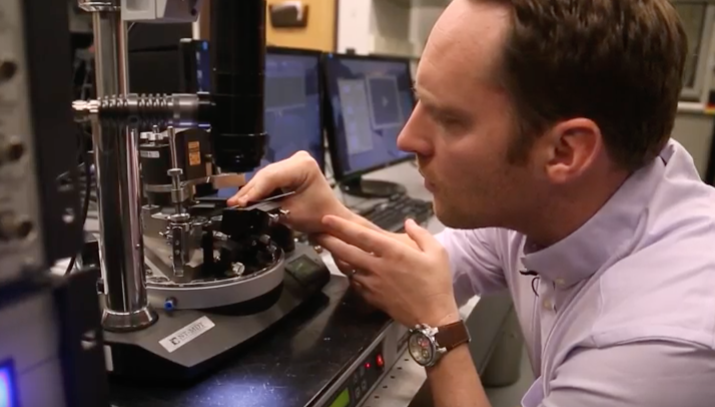
U-M assistant professor of materials science and engineering John Heron believes that entropy-stabilized oxides–metal mixtures that contain as many as eight different elements instead of an ordinary alloy’s two or three-could one day drive a new generation of post-silicon computing devices. By using both magnetic fields and electricity to store data, they could potentially deliver superior performance while consuming a fraction of the power.
The trick is to develop alloys whose conductive and magnetic properties can be dialed in independently. This could create a metal whose magnetic polarity can be “flipped” with a pulse of electricity. Within the bounds of traditional alloying, it’s an extremely difficult feat.
Heron’s approach breaks traditional material boundaries by piling many elements into a ceramic alloy, creating disorder, or entropy. In the stereochemical chaos, the material begins to make its own rules, creating order from disorder and opening the door to a new world of alloys that are far more tunable and versatile.
Heron has taken the first step by showing that entropy-stabilized oxides can show unprecedented improvements in the type of magnetic phenomena used in hard disk drives. His lab is innovating with them right now-watch it happen in this video, or read the paper to learn more.